
AVAO™. It’s pronounced “avow.” As in to declare, affirm or proclaim openly. That’s the core of the new kind of vector database. The meaning-based retrieval of vector embeddings in an auditable, user-sovereign and resilient architecture. Originally developed as our enabling technology for intelligenceOS™ Assistant memory, it became clear that it could serve a vital need for developers.
Dual-stage vector retrieval + low-latency deterministic filtering. Replaceable embedding layers. Regulatory-friendly audit chain from query to result.
-
Canonical data objects with queryable metadata: vectors as query-time refinement for dual-stage retrieval.
-
GDPR Article 17. EU AI Act. Canada AIDA. FRB SR 11-7. Compliance from the architecture up.
-
Multiple embeddings per record. Swap models without structural migration.
-
The technical paper defining the architecture this database is built on. Read more…

Vector. Re-engineered from the ground up.
Current vector databases treat opaque dimensional embedding as the canonical master key that unlocks retrieval and similarity ranking. It allows for sophistication but not inspection. What was retrieved. Why the query returned what it did. How are the data objects related. As developers have searched for a solution, layers of filtering and metadata have been laid on top of this foundation.
AVAO™ inverts the approach. Engineered to treat human-readable categories and metadata as the first-class canonical retrieval basis, with vector annotations to refine and narrow the first-pass query. The solid retrieval core of battle-tested boolean SQL/Postgres. The multi-dimensional sophistication of vector-based associative retrieval.
The data object is the center of the dual-stage query structure, not a satellite to the embedding. The first pass applies deterministic boolean search across semantic metadata: classifications, cross-references, timestamps, provenance fields. This narrows the candidate set to only what's relevant. The second pass refines through latent proximity search within that set, using the full dimensionality of the encoding. Because AVAO™ limits expensive similarity matching to a pre-filtered subset, retrieval is faster and computationally cheaper.
Auditable. Built for defensible, transparent retrieval.
The EU AI Act has exposed needs that aren't met by conventional vector databases: traceable, auditable accounting of retrieval decisions. It joins a growing body of regulatory requirements like the U.S. Federal Reserve's SR 11-7, Canada's Directive on Decision Making, and others.
AVAO's treatment of inspectable metadata as first-class objects with embedding as "annotation" is inherently more transparent by design. Not a bolt-on. The deterministic candidate fencing ensures proximity search operates on validated candidates before any associative matching occurs. Defensible logic gates, not an unbounded black box. Beyond this, the system encodes an audit trail at the time of embedding generation for either neural or computational vector embeds, as well as for scalar values, computational matches, and metadata tags. This is the audit block system.
Combined, the Auditable Vector Annotation Object (AVAO) architecture creates a complete accountability chain that delivers:
Governance across schema and retrieval: every architectural layer is traceable and auditable
Transparency for AI knowledge bases: retrieval decisions are inspectable, not inferred
User sovereignty over their own data: the system answers to the user, not the other way around

Swap. Rebuild. Migrate.
Model Lock in. Obsolete. Multi-vector embedding concurrency means that a single set of data objects can link to more than one vector embed. The result is the AVAO database can be concurrently used by several neural indexing services, or archive rather than replace embeddings to allow for rollbacks of the vector index.
AVAO also makes rebuilding the associative multi-dimensional embeddings straightforward. Because of the data-object-first design with vector annotation, the core relationships between records or AI memory are encoded in an interchangeable natural language format. Re-indexing to a new service is a straightforward regeneration of the vector encodings guided by these relations in a way that's more consistent and stable. The audit block system enhances this further: the expanded record of system reasoning and choices allows increased granularity to ensure the new vectors align with the audit trail.
Together, these capabilities reduce vendor lock-in. AVAO can stably migrate from one vector indexing service and client model to another with minimal reconfiguration, or seamlessly switch between services in a multi-endpoint system.

Resilient. Designed for robust fallback
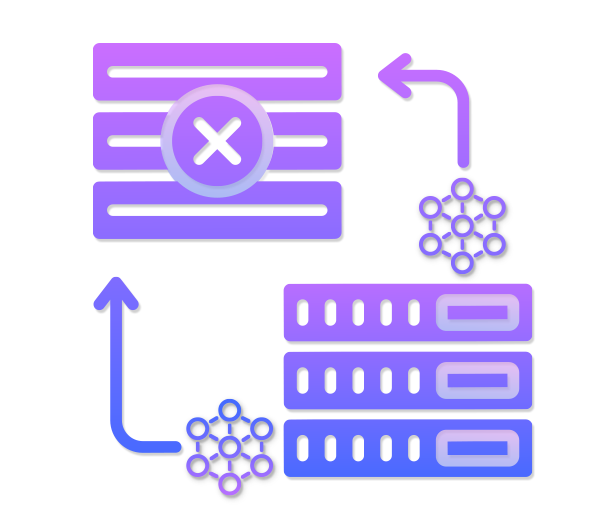
Vector databases have a problem. The embedding pipeline goes down and your retrieval goes dark. AVAO's dual-stage architecture provides the sophistication benefit of associative search with the robustness of vanilla SQL/Postgres.
Stage One candidate retrieval is deterministic. Boolean queries running independent of the multi-dimensional vector encoding. If the embedding service is unavailable, AVAO continues to serve first-pass results with a fallback ranking based on a user-customizable number of results and metadata similarity. Less refined than a full second-pass latent proximity search of the embedded annotations, but available. Operationally robust. Deployment stable.
Some vector architectures have started to layer metadata alongside vector data. But the retrieval pipeline remains single-pass: the retrieval is fundamentally a semantic proximity search of embeddings with metadata as an additional filter during execution. When the embedding service breaks, the full chain breaks. AVAO's fallback resilience is a direct result of its inverted architecture. The data object and its metadata are canon.
Read the Technical Paper.
AVAO™ database, orchestrator and memory agent are based on the Vector Annotation Database framework designed for intelligenceOS™, where we recognized the need for a transparent, robust and auditable memory layer for user-sovereign AI applications. You can read the original technical paper here: