Vector Databases Have a Black Box Problem. The Architecture That Solves It.
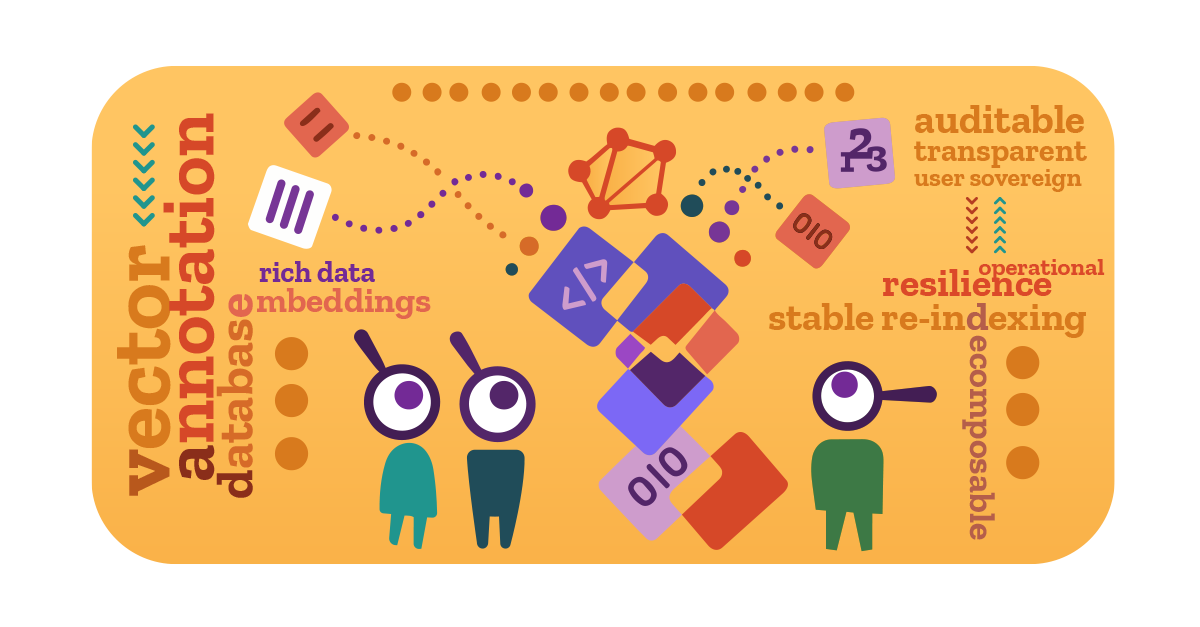
AI governance demands auditable retrieval, but vector architectures can't deliver it. Vector Annotation Databases embed transparency at the architectural level.
The regulatory clock is ticking. The EU AI Act's transparency obligations for general-purpose AI models took effect August 2025. Domestically, Canada’s Directive on Automated Decision-Making and the U.S. Federal Reserve's SR 11-7 model risk management guidance both require that models in regulated sectors provide transparent, challengeable reasoning. This creates a problem for the dominant vector database architecture. The pattern used by every major vendor on the market can't satisfy this requirement to account for what was retrieved, why it was retrieved, and on what basis other candidates were excluded.
• • •
The Opaque Vector
Vector databases have come to be the preferred “AI native” retrieval system. The standard pattern that’s become synonymous with the architecture is using high dimensional embeddings as the main lookup mechanism using proximity nearest neighbor retrieval. But as auditability and user-sovereignty as non-negotiable needs come to the fore, several weaknesses in this approach become clear:
Oracular retrieval logic. The inability to decompose the retrieval decision means that when a query returns irrelevant results or misses relevant ones, the only recourse is trial-and-error adjustments to chunking strategy or query phrasing. There is no mechanism for understanding what went wrong.
Hard embedding dependency. Embeddings generated by model A are noise under model B. Each model produces a distinct latent space geometry. Migration between models requires full re-indexing of the entire corpus. And because the system is an oracle, there's no way to audit how functionally equivalent the new mappings are. The index is coupled to a specific embedding function, model version, and preprocessing pipeline.
Brittle retrieval paths without operational fallback. If the embedding index is unavailable, the database cannot retrieve at all, regardless of what metadata may be present. The embedding path is the only path.
The costs aren't theoretical. For example: a compliance officer searches for "late fee policy after 15 days" and the system returns the standard terms — confident in its semantic match. But for this customer's contract, the actual policy is "late fee may apply after 15 days," a materially different obligation. The officer has no way to know the retrieval missed a critical modifier. And crucially, the system can't tell them what was excluded or why. The retrieval decision is an oracle.
These limitations aren’t implementation quirks or bugs: they’re baked into the architecture of every major product as a structural consequence of a design that conflates the index with the data. The solution? Flip the relationship. This is the vector annotation database.
• • •
Inverting the Architecture
A vector annotation database architecture reverses the relationship between data and embedding. Instead of the retrieval core being the opaque high-dimensional embeddings, it's the explicit, human-readable and deterministic metadata. This approach centers the "data object": the document, the video, the audio. And for the data object the canonical indexing artifact is elements like its semantic text content, cross-references, timestamps, tags and keywords , scalar traits and sparse abstracts. Embeddings are then annotations on that core: replaceable, rebuildable, supplementary. They enrich the retrieval surface without constituting it. They are one of several swappable views that don't touch the canonical data layer.
• • •
How a Vector Annotation Database Works
The architectural consequence of treating embeddings as supplemental annotations to the canonical index is a two-stage lookup process. First, the system narrows the candidate set using familiar Boolean operations over the inspectable fields. This is fully equivalent to any standard SQL or Postgres lookup, with an advantage: a robust indexing service (either computational or using neural models) can create a rich set of flat metadata that captures a stable relationship framework between data objects. The second stage performs approximate nearest neighbor (ANN) refinement on only those relevant candidates, then presents the best result cluster based on match criteria or custom relevance thresholds.
This vector-as-annotation approach has several major advantages…
• • •
The Benefits Unlocked by Vector Annotation
Auditability.The core indexing structure is named and traceable to a specific data source, and the associative logic lives in this human-readable, editable format. Because Stage One retrieval acts on this layer, it can fulfill audit requirements to provide meaningful traceability of the basis on which information is retrieved and presented. Boolean expressions operating over named, inspectable fields such as "domain = 'energy_systems' AND semanticDensity >= 0.70" are inherently justifiable. Stage Two then works within a bounded candidate set whose boundaries are themselves auditable.
But embeddings remain opaque as a dense embedding string. This is where the audit block comes in. At write time, the system can record how each embedding and metadata value was generated, including what was excluded from consideration and why. This can include both the generation decisions of the embedding string and single-axis values like scalars. Because it's created at write time, that trace exists regardless of model changes, index rebuilds, or system migrations. It achieves read-time accountability for stage two approximate nearest neighbor search because its creation context is fully documented and challengeable—and the search area is bounded by deterministic fencing.
Stable Re-Indexing. A key advantage of vectors as annotations is robustness, not just transparency but structural resilience of the index itself. Treating the data object and its metadata as canonical creates a portable interchange layer: the cataloging and associative relationship framework can move between embedding services without regenerating from scratch. In a standard vector database, changing embedding models requires a full re-index, computationally intensive and slow, with no accountability that the new relationships are consistent with the old. With this architecture, re-indexing only touches the annotation layer. The canonical framework, including field definitions, cross-references and relationship mappings, persists unchanged. And the audit block extends this further: it preserves the embedding reasoning, enabling verification that new embeddings remain functionally consistent with the old across model migrations.
Multi-Embedding Concurrency.Because embeddings are treated as a metadata layer, the architecture allows a single set of canonical data objects to link to multiple embedding models simultaneously. Different query types can route to different models. Different front-end systems can serve different users through their preferred embeddings, all hitting the same stable index. The result is side by side A/B comparison on identical data objects, not approximated across shifting indices.
As an example: a legal research platform serving 5,000 corporate attorneys indexing rulings from 14 circuit courts wants to test LegalBERT-base against their current general-purpose model. Instead of being offline during a 14-hour full re-index of 3.2 million documents, the system continues running on model A while the index for model B generates using stable re-indexing. Once done, attorneys can toggle between both models because both embeddings work against the same index. Testing is apples to apples… the stable re-indexing ensures the canonical framework hasn't shifted. A user searching "*forum non conveniens"* retrieves the same precedents like Gulf Oil v. Gilbert regardless of which model serves the query—the attorney can utilize their preferred system—or if doing A/B testing, evaluate the AI system's analysis, not whether the retrieval was consistent across model boundaries. And should LegalBERT not work out, reverting is simple, because both embeddings exist as linked tables to the same canonical data core.
Operational Fallback.In the legal research platform example, system resilience is vital… high-demand sectors can’t afford the downtime. This is another area where the deterministic canonical data core with vector annotation architecture has a distinct benefit. In the industry prevalent vector database approach, if an embedding service becomes unavailable (for whatever reason), the database stops functioning. Period. Full stop. The vector embedding is the index. Even in systems that have a layer of Boolean friendly metadata, the filtering mechanism it enables is still part of the singular query flow to enhance the vector retrieval.
The two-stage retrieval architecture means that stage one can retrieve records based on core relational metadata using standard Boolean queries from the SQL/Postgres tables as an airlocked first pass process. if the embedding annotation service is offline, the system can nevertheless activate computational ranking and filtering on the candidate subsets and present output, by criteria such as: number of results, semantic similarity or scalar values. While lacking the richer data representations that capture subtle proximity relationships during this downtime period, it will still function similar to a standard relational database.
In Conclusion: Moving Beyond Vector-First Search
As we've seen, the standard vector database architecture builds retrieval on an opaque, single-path foundation. From retrieval decisions that can't be examined to model migrations that require full re-indexing and systems that go dark when embedding services fail, these aren't implementation issues. They're structural. Embedding-as-index architecture can't deliver the auditability and resilience enterprises need. The solution is inverting that relationship: data objects as canonical, embeddings as annotation.
The full technical paper that includes architecture specification, formal definitions, and implementation guidance is available here:
SSRN Preprint DOI: https://doi.org/10.2139/ssrn.6862338
Technical Paper: Open PDF (Download)
Technical Paper: Read Online (HTML Viewer)
About the author: Ian Tepoot is the founder of Crafted Logic Lab, an independent AI research and development studio focused on cognitive architecture and humanist AI. The Cognitive Architecture Framework, General Cognitive Operating System and Vector Annotation Database are patent-pending. Thought is Attention Organized is the first of a series of work on the Hephaestology engineering framework.