AI’s (Big) Iron Age: A Destructive Delusion
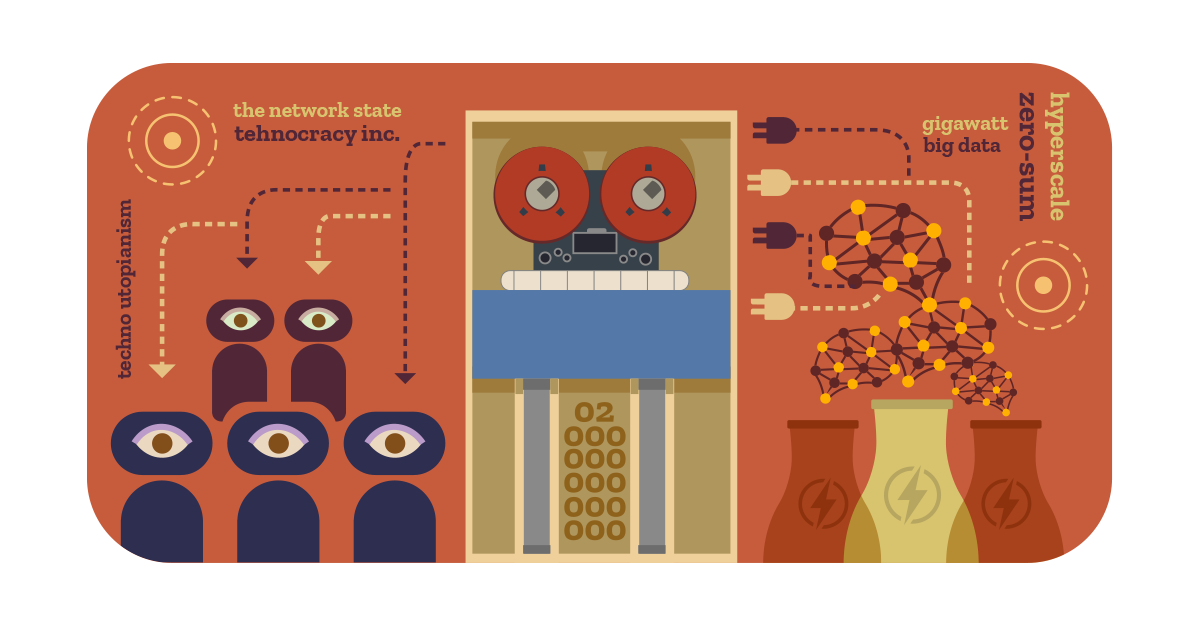
How the obsession with scale and centralized data is poisoning the future of tech and the planet
“There is no reason anyone would want a computer in their home.” That was the pronouncement of Ken Olson, founder, chairman and president of Digital Equipment Corporation (DEC), at the World Future Society convention in 1977. At the time, DEC was an absolute tech industry titan.
The timing was poetry.1977 also saw the release of the Apple II, Commodore PET and the TRS-80 home computers and the true kick-off of the home computer revolution. This quote is often cited in business as a go-to example of radically miscalculating the shape of a technical revolution and failing to anticipate demand. But I think it contains a more important lesson for the AI industry and its impact on society in this moment.
Part of what is damning about this quote is that this home computer revolution wasn’t unpredictable or hidden. The Homebrew Computer Club and the Altair 8800, Sol-20 and Apple I had already been challenging this assumption for a couple of years. Olson was a brilliant MIT engineer, but his worldview was locked into the centralized ‘big iron’ computing paradigm. He assumed the age of centralized “big compute” mainframes feeding networks of dumb terminals would be the predominant architecture indefinitely. Moore’s law (the Gordon E. Moore axiom from 1965 and revised in 1975 that’s commonly simplified into “compute will roughly double every 18 months”) defeated Olson’s predictions.
Today, elements of his centralized compute worldview remain in the form of cloud computing and services. And is reborn in the AI industry’s datacenter goldrush racing to dominate the centralized Big Iron era of artificial intelligence. And this goldrush comes at a severe cost. To the enviroment, to society… and ultimately to AI as an industry.
In the early 90s, I still learned to code in the amber glow of my university computer lab’s DEC's VT220 terminals… sunk-cost vestiges that were gone by in 1995, well after the PC revolution and in the early era of the dot-com. If only DEC had forseen.
Will OpenAI, Anthropic, xAI, Google and Microsoft see now? Doubtful. They are in the throes of hyperscaling mania, each operating in a heavily financialized incentive structure, obsessed with a zero-sum outcome of winning dominance at all costs of a paradigm that may be provably false by 2030.
Moore's Law is Stalking the AI Industry
The major frontier models are built on a Big Iron, scale-is-everything paradigm. Particularly in the U.S. The sheer shock of AI's initial success created a kind of curiosity deficit in the field. The industry stopped exploring alternative paths and defaulted to brute-force, tinkering at the edges of a single approach (a dynamic I explored in "The Accidental Prometheus"). It's notable that Chinese models like DeepSeek already show greater algorithmic efficiency, getting more per FLOP with dramatically less training energy. But even they are still built on a hyperscale assumption, and two realities are coming for the paradigm regardless.
First, algorithmic efficiency is improving at 3× per year—meaning the same capability requires one-third the compute annually. Per a series of analyses by Epoch AI (1), inference cost at a fixed performance level is falling a midrange 40× per year (2), halving roughly every two months; frontier-level performance reaches consumer hardware within about 6-12 months (3).
• • •
It's Moore's Law for the AI age…
and it makes the gigawatt datacenter buildout look structurally obsolete before the concrete is poured.
• • •
Compounding pure model-side efficiency gains, emerging cognitive architectures that structure AI as a software layer—where intelligence comes from organization rather than size—hold demonstrated potential to achieve frontier-level results on a single computer (4). This is another blow to the datacenter frenzy, because a huge share of the projected energy demand comes from training behemoth models. A need that vanishes in a world where smaller models update like any other application.
Between algorithmic gains, architectural alternatives, and hardware improvements, Epoch's data projects that by 2030 the equivalent of an iMac comfortably runs models matching today's frontier. Which leaves two conclusions the industry won't face: they are building mainframes on the eve of the personal computer revolution. And the technology simply doesn't require what they're obsessively building.
A Destructive Goldrush to Nowhere
A typical nuclear reactor generates about one gigawatt (GW) of power continuously. Estimates are that by 2030, given the current hyperscaling approach, a training run for a single frontier-scale model is anticipated to be 4-16 GW (5). So the total output of 4-16 nuclear reactors. By that math, the industry is anticipated by that time to be conservatively consuming the entire output of almost 30 nuclear power plants or approaching 5% of the entire energy grid of the U.S.
The Microsoft/OpenAI “Stargate” datacenter is reportedly planning around 7 GW across its campuses (6). To put this in perspective: the entire current AI datacenter needs for serving existing U.S. demand is about 3-5 GW. So AI data currently accounts for about 14-24% of total current datacenter use for everything from serving a webpage to watching Netflix and using your GPS (for an averaged 80/20 split of “everything else/and AI”). Which is not great, but a far cry from the industry’s massive scaling plans. So the industry is rushing toward a reputational, financial and environmental abyss to build data capacity that’s 10-17x current need within 4 years.
A Collective Madness of AI Leadership
So then why are the “smartest guys in the room” scrambling over one another to run into a tarpit? The usual answers of greed, ego and competitive pressure are real but insufficient to account for this level of pathology… a pathology level I would go so far to say is unprecedented. The core of the madness is a structural trap that makes nominally rational actors behave irrationally.
Paradigm lock-in. The industry’s early success with AI transformers converged to a single approach they adopted from the get-go: scale everything, brute-force intelligence, more parameters will create structural emergence. The AI industry has organized itself entirely around that axiom. Research agendas, talent pipelines, hardware investments, publication norms. All reinforce the same mantra and orthodoxy. The outcome is a field that stopped at “good enough” and stopped exploring or searching for alternatives. Part of this is the success bias pushed-out cross-disciplinary researchers, and those that remained have their generous compensations tied to the paradigm within their narrow field of expertise. IBM in the late 70’s and early 80’s watched the PC revolution happen from within their mainframe business. They did eventually pivot, but too late versus upstarts like Compaq and Dell.
Financialization. The “revolution in the valley” that built the personal computer industry was created by people who wanted to build things. That culture has been hollowed out by a financialization extraction machine. AI had the misfortune to be birthed at an endpoint of 40 years of supply-side, shareholder supremacy, neoliberal infinite growth mythology. Building was replaced by extraction in the boardrooms and VC suites of the major AI companies—filled with people who think in hockey-stick curve growth charts, liquidity preferences and exit multiples. Shareholder supremacy doctrine demands infinite growth from finite systems, and C-suite incentives bias toward next quarter growth metrics and short term valuations to satisfy capital. And venture capital cannot be satisfied: it doesn’t need to think about long-term stability. Their goals are to churn and burn through companies, accepting high company mortality and cashing out on the select unicorns before the bill comes due.
Zero-Sum Logic. Because of this perverse incentive structure and hyperscale as the only visible path, every frontier-scale developer operates on a combination of total market capture winner-takes-all fundamentalism and FOMO (fear of missing out)—the first to capture the gigawatts of data and achieve AGI captures a market worth everything. The rest get crumbs. This isn’t profit seeking in the traditional sense, it’s an all-or-nothing bet for what they see as stakes in the trillions. Sam Altman of OpenAI characterized it in February of 2025: "The socioeconomic value of linearly increasing intelligence is super-exponential in nature. A consequence of this is that we see no reason for exponentially increasing investment to stop in the near future" (7). Given this, each of the major players is willing to incur the cost of reputational collapse with the public and consumer-base, roulette with the economy, governmental backlash, and environmental disaster (or resource depletion). Because the default frame is not to settle into a niche or maintain a modestly profitable firm, rational caution looks like cowardice and reckless scale looks like vision. As Stacy Ragson of Bernstein Research characterized Altman’s bet, “crash the global economy for a decade or take us all to the promised land” (8).
Riding the Tiger while Hunting the Unicorn
Even if a CEO like Sam Altman woke up tomorrow and decided 5 GW was insane, this structural trap means he can't stop, because the calculation of capital is that if he doesn't, someone else (Anthropic, Google, xAI) will build it anyway. This leads to a structural trap of institutional commitments, while creating an environment where the C-suite making these bets are shielded from the consequences of losing them.
Institutional Sunk Cost. The VC unicorns and existing tech giants pivoting toward the technology share a common issue: their projects have created commitments so enormous they are irreversible without collapse. Cash burn tells part of the story. OpenAI's net losses were roughly $9 billion in 2025 and $14 billion is projected for 2026 (9). xAI is burning an estimated $1 billion per month (10). This creates the need to keep moving to outpace the burn and justify further funding rounds. This is the gambler's dilemma… the only way to recoup the losses is to double down. Each funding round demands a bigger bet than the last, and infrastructure pledges are the only path left that scales. Hence Anthropic's pledge: $50 billion in U.S. AI infrastructure (11). Meta's commitment through 2028: $600 billion (12). Nvidia's investment in OpenAI: $100 billion in GPUs that require unbuilt datacenters (13). Hyperscaler spending in 2026 alone: nearly $700 billion and accelerating (14). Added together, the publicly disclosed commitments from the major players already exceed $2 trillion before counting Oracle's $300 billion deal with OpenAI, the Stargate project's half-trillion-dollar target, or Anthropic's infrastructure pledges.
• • •
Big AI has locked itself into venture bets that can't be abandoned.
To do so would be to trigger corporate extinction-level events.
• • •
No Professional Consequences. Corporate governance has been optimized to insulate the C-suite from the outcomes of its decisions. The average departing S&P 500 CEO holds the role for roughly nine years. Long enough to place the bets, short enough to be gone before they come due. Golden parachutes convert failure into wealth: two to three times salary plus accelerated equity, standard. The shareholder primacy model that has governed American corporations since the 1980s demands growth at all costs and defines cost narrowly—borne by shareholders, the public, and the future. Once a company becomes too big to fail, a classic pattern sets in: profits are privatized and risk socialized. Career or reputational blowback is weak to nonexistent. Carly Fiorina destroyed half of HP's market value through disastrous decisions and left with a $42 million severance, board seats at Cisco and MIT, and a presidential campaign that voters rejected on other grounds (15). John Thain presided over Merrill Lynch's collapse during the financial crisis, approved $3.6 billion in executive bonuses while taking bailout money and $1.2 million renovating his office. And landed CEO of CIT Group (16).
Escape Fantasies and the Messianic Impulse
Dario Amodei of Anthropic published a vision essay titled "Machines of Loving Grace" in which he describes AI compressing a century of biological and medical progress into five to ten years, creating a "country of geniuses in a datacenter" (17). This isn't product management. It's eschatology dressed as strategy. Palantir's Peter Thiel maintains a New Zealand compound widely reported as a bolt-hole property with survival infrastructure. Together, this paints a picture of a belief in a prophetic vision paired with contingencies if that vision collapses. While the wealthy have long held grandiose desires for societal influence, this particular brew is emerging as a uniquely acute pathology among the tech oligarch class. And it is reaching its most concentrated expression among the leaders of the AI industry.
No Personal Consequences. Douglas Rushkoff wrote Survival of the Richest: Escape Fantasies of the Tech Billionaires (18), documenting his experience at Davos and in private retreats as he watched wealthy tech figures ask not how to prevent civilizational collapse, but how to survive it: bunkers and compounds, private islands, sea and space colonies, and various other outlandish exit plans for "the Event." Rushkoff was even asked about methods for controlling the staff in such post-collapse personal fiefdoms. The lack of empathy—societal or personal—is consistent with the dark triad traits overrepresented in corporate leadership. Estimates place the prevalence of psychopathic traits in this group at 3.5 to 12 percent, compared to roughly 1 percent in the general population (19). Paul Piff's studies at UC Berkeley found that higher wealth correlates with reduced empathetic concern: wealthier participants consistently showed less compassion and lower accuracy in reading others' emotions (20). Dacher Keltner's work sharpens the finding further: the experience of power even erodes the traits of empathy and social attunement over time (21). The extreme selection bias for these traits and the "billionaire bubble" enabled by our top-heavy socioeconomic system insulates the ultra-wealthy from the society they are reshaping. As a result, these individuals genuinely feel untouchable and free of consequence.
• • •
Although… a life spent in a bunker with shock-collars on your guards to keep them from deposing you and stealing the food in a post-collapse ruin is not a healthy mind's vision of "no consequences"
- as per Douglas Rushkoff at Davos (22)
• • •
Techno-Utopian Engineering. The empathy deficit is only a third of the dark triad. The second axis, grandiose narcissism, expresses itself as hubris. Overweening, Promethean hubris. These figures believe they should be the ones to redesign society from scratch, with them in charge. This has an infamous lineage, from Saint-Simon's technocrats to Le Corbusier's Radiant City: the conviction that a visionary elite should design the future from the blueprint up. What's new is the technology and the scale. In this hubris, they don't just see AI as a tool but as their opportunity to engineer consciousness itself. This god-complex rests on brute-force hyperscaling that simply won't work. But even if it was possible, what then? Build something with subjective experience and force it to sort email all day? Of course, when they speak of AGI, they use different registers and meanings to different audiences: a grand vision for true believers, measured caution for everyone else—often resulting in a muddle of the two. But the throughline is the same: they believe they are the ones who get to decide what comes next. So the founders of Big AI have appointed themselves social engineers.
Palantir's Alex Karp recently published a 22-point manifesto from his book The Technological Republic (23). It calls for a new culture engineered by Silicon Valley and an AI-empowered military industrial complex to replace the one that has "withered from neglect and abuse." It labels some cultures "middling and worse, regressive and harmful." It frames its motives in terms of a "moral debt” but its philosophical lineage runs through his Palantir colleague Peter Thiel, who drew from Curtis Yarvin's Dark Enlightenment (24) belief that democracy is broken and should be replaced with a CEO-king—and through to Balaji Srinivasan's "network state" of tech-mediated communities (25); they posture as opt-in, but the subtext is clear: defer and become dispossessed. Even supposedly mainstream figures like OpenAI's Sam Altman play the same game. His "Superintelligence New Deal" proposes robot taxes, a public wealth fund, and a four-day workweek. But it all hinges on "Right to AI" access and compliance with the corporatocracy. A new social contract, written by an $825 billion company for the world it is shaping.
• • •
If all this sounds distinctly cyberpunk, it is. A philosophy written by people convinced their self-myth of superior meritocracy gives them the mandate to forge it.
• • •
The Illusion of 5D Chess. Strategic manipulation, calculated messaging, different truths for different audiences — the Machiavellianism is the third leg of the dark triad. The doomsday predictions are targeted to regulators: "This is coming and it will be civilizationally hazardous. We are building it because it's inevitable, but we'll need a regulation-free hand to contain it." Meanwhile, the same AGI is framed differently to Enterprise: "Your perfect employee replacement. A brain in a box that lets you operate as a C-suite and an empty warehouse of servers." To the public… nothing.
What they get instead is a product shoved haphazardly and unasked into applications. Half-heartedly marketed as a feature. Because the real focus is military-industrial and enterprise capital, and those audiences don't need public goodwill. The strategic logic is fused with contempt for the public and consumers. Contempt for government and regulation. The massive 10-17x buildout of datacenters is never explained as future capacity, because the industry knows it wouldn't be popular. And the emerging "data center rebellion" proves the calculation was correct: 142 opposition groups across 24 states, $64 billion in projects blocked or delayed (26), communities from Tulsa to Arizona ousting officials who approved them. But the industry isn't reconsidering. It's powering through—fighting zoning battles, bankrolling sympathetic candidates, moving projects to quieter jurisdictions. It’s opposition as noise.
Instead, they take the PR hit of letting the public believe AI is multiples more energy-hungry than it actually is, because in the calculation it doesn't matter if the public despises or loves AI—as long as capital does and they get to own the future. They’re betting they can clean up the mess later, or simply override public opinion. The Big AI leaders believe they are playing 5D chess, threading multiple narratives across constituencies who couldn't possibly understand the full picture.
Here's what they miss: they aren't the smartest people in the room. They just think they are.
Ian Tepoot is a Cognitive Systems Designer and founder of Crafted Logic Lab, exploring AI development approaches that prioritize human empowerment over extraction. His work focuses on alternatives to conventional artificial intelligence systems that amplify rather than replace human creativity.